
Lower electricity bills
Every unit you export earns a credit, so a well-sized system steadily reduces your monthly cost of grid power.
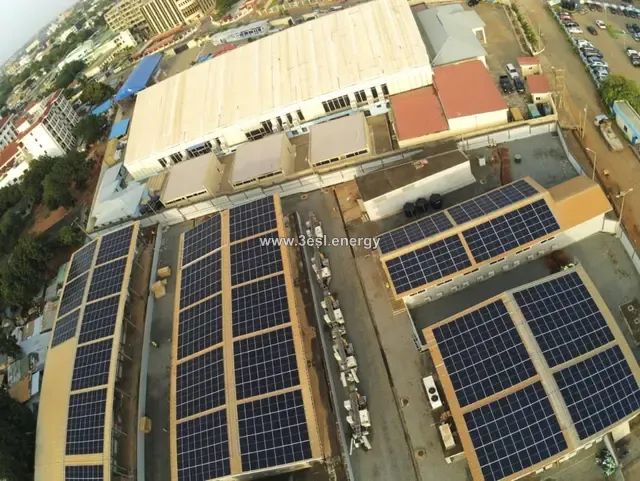
As a licensed solar PV engineering firm, 3ESL designs and installs grid-tied systems (including hybrids with battery storage) that meet Energy Commission and utility requirements — and guides you through the net-meter application from site assessment to commissioning.
A billing arrangement, not a piece of equipment. You pair a grid-connected solar PV system with your existing supply and get credited for the power you send back or feed into the grid.
Under the Net metering code, a customer who generates their own renewable energy becomes a customer-generator. The surplus your solar system exports to the distribution network is credited to your account and offset against the electricity you later draw from the utility.
It is designed to supplement your supply, not to run a power-selling business - it is not an income-generating mechanism. That is why the solar system must be sized around your own demand - and why a system sized to export for profit is the wrong system that will impact your investment into solar.
Worth knowing: approved taxes, levies and service charges on the electricity you consume still apply, and credits cannot be used to offset those.
Every unit you export earns a credit, so a well-sized system steadily reduces your monthly cost of grid power.
Distributed rooftop generation eases pressure on the national grid and strengthens supply, particularly at peak demand.
Because credits are set against electricity you would otherwise buy, you capture value from generation that would otherwise be wasted.
Net metering supports Ghana's renewable energy targets and the shift toward a cleaner, more diverse energy mix.
Straight from the Code
Every answer below is our paraphrase of the Energy Commission of Ghana's Net Metering Code (2023), with the section cited so you can check it.
Net metering is a billing arrangement, not a piece of equipment. You connect a grid-tied renewable system alongside your normal supply, and the surplus your panels send back to the distribution network is credited to your account and set against the electricity you buy later. The Code's own term for you once this is in place is a customer-generator.
The important consequence is in the design brief: net metering is intended to supplement what you buy, not to run a power-selling business — the Renewable Energy (Amendment) Act, 2020 says it is not an income-generating mechanism. So the system gets sized around your own demand, and a system sized to export for profit is the wrong system.
Energy Commission of Ghana — Net Metering Code (2023)
Credits offset the electricity you draw later — at night, or on a cloudy day — so they reduce what you owe rather than paying you cash. They roll over between billing periods, and the arrangement is settled over an annual tracking period, so a surplus built in the bright months can carry into the darker ones.
Two limits worth knowing before you size a system around them. Approved taxes, levies and service charges on the electricity you consume still apply, and credits cannot be used against those. And the scheme assumes that over the year you will not export more than you import — which is another way of saying it is not designed to make you a net seller.
I can't quote a credit rate: the Code sets the mechanism, and the tariff and charges are set separately by the PURC and may be changed periodically.
Energy Commission of Ghana — Net Metering Code (2023)
The Code covers connections to the low-voltage distribution network — nominal voltage below 1 kV — which is where homes, SMEs, commercial premises and public institutions sit. In practice that means customers of ECG, NEDCo and Enclave Power.
To actually get connected, the installation has to meet the Code's technical and safety requirements, which is the part that decides most applications: anti-islanding that ceases to energise within two seconds, a visible and accessible disconnect device, correct earthing, surge protection, and an inverter certified to the relevant IEC and IEEE standards. The utility also has the right to witness commissioning and to keep a copy of the test data.
3ESL handles this as your EPC — design, install, commission and the application itself.
Energy Commission of Ghana — Net Metering Code (2023)
A net-metered system must stop energising the network within two seconds of losing utility voltage. This is anti-islanding protection, and it is not optional — it exists so a lineman working on a supposedly dead line is not killed by your inverter back-feeding it.
Coming back is deliberate too: the grid has to be stable for at least five minutes before the system resynchronises — voltage within 90–110 % of rated and frequency between 49.8 and 50.2 Hz — and on a network with automatic reclosing, the system waits at least five minutes for the recloser to normalise first.
This is the thing people are most often surprised by: a plain grid-tied net-metered system goes off during an outage, along with everything else. If you want power during dumsor you need a hybrid inverter with battery storage and a properly configured backup circuit. That is a different design, and we build both — worth saying which one you actually want early.
Energy Commission of Ghana — Net Metering Code (2023)
The Code draws two lines, both in kVA:
There is also a note worth flagging early on rural or long-feeder sites: on a long feeder spur the maximum capacity may need the utility's approval, and may force a three-phase connection regardless of what the numbers above allow.
That threshold is one of the first things we check at the site assessment, because it changes the inverter selection and therefore the price.
Energy Commission of Ghana — Net Metering Code (2023)
The inverter has to be certified against the standards the Code names, not merely sold as grid-tied:
And there is one requirement people miss because it sits in the power-quality section rather than the inverter section: DC current injected into the AC side must stay below 1 % of the unit's rated output current.
Energy Commission of Ghana — Net Metering Code (2023)
The operating envelope, straight from the Code:
Modern certified inverters meet all of this out of the box. It matters at design time because it constrains protection settings, and at commissioning because it is what gets tested.
Energy Commission of Ghana — Net Metering Code (2023)
The parts that most often come up on an inspection:
The Code is explicit that protecting the facility is the customer-generator's responsibility under all conditions — including when the system is not running.
Energy Commission of Ghana — Net Metering Code (2023)
Commissioning runs after the interconnection is installed and ready, and the utility may attend and take a copy of the test data. The tests the Code lists are:
You or your installer must supply the engineering drawings, schematics and testing certificates for the equipment and protections. The utility can also test the protection relays and controls before final approval — or at any time afterwards.
On our jobs the results go onto an instrument-recorded electrical test record and commissioning report, signed, so the evidence exists later when somebody asks. That is the same discipline whether or not the meter is a net meter.
Energy Commission of Ghana — Net Metering Code (2023)
A bi-directional meter that records import and export energy separately. All meters on the distribution network are the supplier's property even when they sit on your premises, and the supplier is responsible for designing, providing, installing, operating, maintaining, testing and sealing the meter.
So the meter is the utility's part of the job. Ours is everything on your side of it, plus getting the application through.
Energy Commission of Ghana — Net Metering Code (2023)
Ghana's net-metering rollout runs under the Scaling-Up Renewable Energy Programme (SREP), backed by the Government of Ghana with the African Development Bank, the Climate Investment Funds and Switzerland's SECO. Under that national programme, systems below 10 kWp for SMEs and private homes may attract a subsidy, and there is a national online application portal.
I'm deliberately not quoting an amount or a current status — programme terms change, and the subsidy sits outside the Net Metering Code itself, which is the document I answer from. Ask us and we will tell you where it stands this month, and whether your system falls under the threshold.
Apply
This is the short qualifier, not the regulatory form. The Energy Commission application asks for your Ghana Card, an electricity bill, inverter serial numbers, isolator ratings and an installation completion certificate — things that only exist once a system is installed.
So we ask first whether you already have a system. If you do, you are ready for the application and we file it as your EPC. If you do not, we start where the answer actually comes from: a site assessment.
Prefer to talk?